
Social Licence in Horse Sport
Social Licence in Horse Sport: The Role of Welfare-Led Event Environments
Horse sport is increasingly judged through the lens of public trust. Across governing bodies, event organisers, venues and competitors, there is growing recognition that confidence in the sport depends not only on what happens during performance, but by how horses are cared for across the wider event environment. This is particularly relevant where welfare-led temporary stabling is used as part of the event environment.
Together, these developments reflect a clear shift in how the sport is evaluated. Welfare can no longer sit within rules or guidance alone. It must be evident in practice, in how horses settle, rest and are managed throughout their time on site.
Recent research across the UK horse sector, including work led by World Horse Welfare in collaboration with British Equestrian, highlights a clear shift in expectations. There is now greater emphasis on welfare being consistently delivered in practice, not just defined in policy.
As Roly Owers, Chief Executive of World Horse Welfare, has said, “public trust depends on concrete actions, not just words.”
Welfare must be evident in practice
In practical terms, that means welfare cannot be treated as a separate consideration. It cannot be reduced to a set of requirements to meet. It must be built into the environment itself. At events, that comes down to how stable areas are planned, designed and prepared. These are the conditions that shape how horses settle, rest and recover, and they play a direct role in how the sport is experienced and judged.
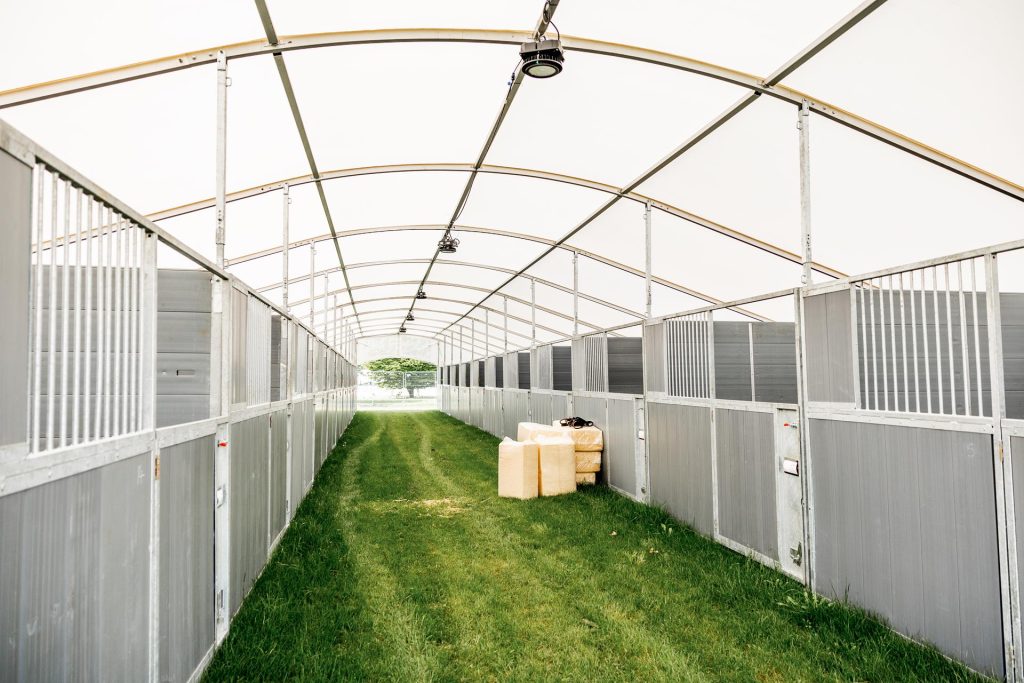
At horse sport events, the stable areas play a central role in shaping the wider environment, particularly where temporary stabling is used. They are where horses arrive after travel and where grooms and riders carry out the routines that underpin both welfare and performance.
Anyone who has spent time on a stable line will recognise the difference. Some environments feel calm and settled; others do not, and that difference is rarely accidental.
In practice, welfare does not sit alongside delivery. It is shaped directly by how these environments are planned, designed and managed from the outset, through structured site planning and coordinated on-site delivery, as outlined in our approach to planning and delivery.
The role of environment in modern horse sport
Expectations around welfare in horse sport have evolved. As a result, the conversation is no longer focused solely on performance or outcomes. It now extends to how horses are managed throughout their time on site, how they recover from travel and exertion, and how consistently their routine and wellbeing are supported.
As a result, the role of the event environment becomes clearer. Stable areas influence how horses settle after arrival, how easily they can rest, and how effectively grooms can maintain consistent care. Ventilation, space, layout and materials all contribute to those outcomes, particularly in temporary stabling where conditions must be carefully managed.
Guidance from organisations including British Horse Society reinforces the importance of airflow, low-stress environments and appropriate stable design in supporting equine health and recovery.
These are the details that support horse health, allowing horses to rest, recover and settle more naturally.
Welfare-Led Temporary Stabling in Design and Planning
Delivering good welfare at events is not the result of a single decision. It is the outcome of a series of choices made early and carried through consistently.
Site layout determines how stable areas are positioned in relation to noise, movement and other activity. Access routes affect how horses move through the site. The structure and materials used influence airflow, hygiene and safety.
Our approach to welfare-led temporary stabling is grounded in welfare-led design. This means thinking carefully about airflow, space and how easily each stable can be effectively cleaned between uses.
Welfare-Led Temporary Stabling: Temporary Environments, Permanent Expectations
Temporary infrastructure plays a central role in horse sport events, enabling organisers to accommodate large numbers of horses safely and efficiently.
That flexibility is essential, but expectations around welfare do not change depending on whether a structure is permanent or temporary.
Horses still need to feel settled, rest properly and maintain routine. Grooms still need environments that allow them to deliver consistent, high standards of care.
For that reason, welfare-led temporary stabling must meet the same expectations as permanent facilities, supporting airflow, hygiene, safety and stability in all conditions.
You can read more about this in our article on welfare-led temporary stabling design.
A shared responsibility across the industry
Maintaining social licence is not the responsibility of any one organisation. It depends on the combined efforts of organisers, governing bodies, suppliers and partners working to uphold high standards across every part of the event environment.
Event organisers define expectations and priorities. Suppliers contribute through the systems, structures and expertise they bring. Together, these roles shape how welfare is delivered in practice.
As highlighted in British Equestrian’s wider work on participation and public value, sustaining the future of horse sport relies on maintaining trust, access and responsible practice across the entire ecosystem.
“Public trust depends on concrete actions, not just words.”
As Roly Owers, Chief Executive of World Horse Welfare
Looking ahead
Public trust in horse sport will continue to be shaped by how horses are cared for and how consistently those standards are applied. At events, that comes down to the environments horses are placed in, and the decisions made in planning, design and delivery.
When welfare is embedded in those environments from the outset, it strengthens both horse wellbeing and confidence in the sport as a whole.
Further reading and resources
For credible guidance and sector-specific information on infection prevention: